


Filtrer par

50 résultats
Exporter les résultats sélectionnés
Sélectionner tous les résultats de la page
-
Notice détaillée
Titre :
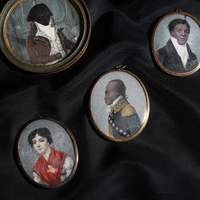
Miniatures, Toussaint Louverture avec les membres de sa famille Isaac Louverture, Placide Louverture et Louise Chancy Louverture, Collection Mupanah, Ville de Port-au-Prince, 2013.
Auteur :
Lo Calzo, Nicola (1979-....)Lieu de la prise de vue :
Port-au-Prince
Date :
2013
Extrait de :
Cham, la mémoire vivante
Type :
Photographie - Couleur
Description :
Le mythe de Dessalines fait ombre à celui de Toussaint Louverture : Toussaint Louverture n’a pas laissé de descendance et la plupart des anciennes familles haïtiennes revendiquent une ascendance directe du général Dessalines. En effet, dans l’imaginaire collectif haïtien, Dessalines est considéré le vrai libérateur de l’île et non Toussaint Louverture, comme voudrait la tradition républicaine européenne.
Conditions d'utilisation :
CC-BY-NC-ND - Attribution - Pas d'utilisation commerciale - Pas de modification
Provenance :


-
Notice détaillée
Titre :
Mr. Ogougnidé BABALOLA, great grand-son of LAGOUNAN, Ketou, Benin Mr. Ogougnidé is a peasant and the guardian of the Akaba Idena (the magic door) of the former fortified entrance to the old Ketou Kingdom.
Auteur :
Lo Calzo, Nicola (1979-....)Lieu de la prise de vue :
Bénin
Extrait de :
Cham, la mémoire vivante
Type :
Photographie - Couleur
Description :
According to him, his great great grandfather Lagounan was “abducted and deported by the Portuguese to Bahia”. “Only his name and the memory of these raids remain as a souvenir”. A testimony from the royal records states that Lagounan was deported during the destruction of the city of Ketou in 1883, by the troops of Glele, King of Dahomey (1858-1889). This story is consistent with the politics of slavery the Kingdom of Dahomey led, as early as the XVIIth century, when it organized and built its wealth on the trade of war prisoners, who were sold to European traffickers. Ketou, Benin
Conditions d'utilisation :
CC-BY-NC-ND - Attribution - Pas d'utilisation commerciale - Pas de modification
Provenance :
-
Notice détaillée
Titre :
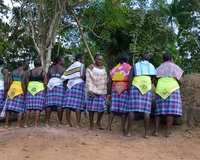
Na dong mi dong lobihe Groupe of Captain women showing their decorated textiles at the funeral ceremonies in the Asindopo village.
Auteur :
Lo Calzo, Nicola (1979-....)Lieu de la prise de vue :
Suriname
Extrait de :
Cham, la mémoire vivante
Type :
Photographie - Couleur
Description :
In the middle Captain Alele Amoida, «Booko de» ( the day before the burial), Saamaka territory, Surinam. They wear skirts held by a kind of scarf (folded into a triangle shape) with embroidered texts in tribute to the deceased. Women’s textile arts, produced as exchange gifts for a husband or lover or for special events such as a burial, have transformed greatly as access to trade cotton from the coast has increased. Trends in fashion change quickly, utilizing elaborate embroidery, appliqué, and patchwork, with women freely borrowing from others while making it their own.
Conditions d'utilisation :
CC-BY-NC-ND - Attribution - Pas d'utilisation commerciale - Pas de modification
Provenance :

-
Notice détaillée
Titre :
Petit-Paris district, Basse Terre.
Auteur :
Lo Calzo, Nicola (1979-....)Lieu de la prise de vue :
Basse-Terre
Extrait de :
Cham, la mémoire vivante
Type :
Photographie - Couleur
Description :
Preparation of the “Mas-a-kongo déportaisyon”, Voukoum group The phenomenon of the reinterpretation of the past and the African origin is clearly present in the case of the «Mas-a -Kongo». This mask consists of coating the body and the face with a mixture of sugarcane syrup and soot collected in the chimneys of the sugar factories. Once again here, the elements have lost a part of their original meaning (referring to the cult of the bear or the savage man in the Indo-European carnival), to assume a new symbolism derived from the local context. Indeed, the Congo Mask is presented as symbolizing the African origin of the Caribbean people, because of its exacerbated black color. On the other hand, this image reflects of very occidental and colonial vision of the African savage. Nevertheless, this “Congo mask”, with its ambiguous origins, is considered the strongest symbol of the Antillean people’s Negro origins.
Conditions d'utilisation :
CC-BY-NC-ND - Attribution - Pas d'utilisation commerciale - Pas de modification
Provenance :
-
Notice détaillée
Titre :
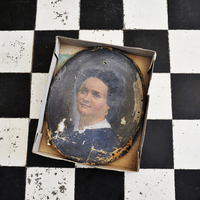
Portrait de femme, Collection privée de la famille Chéné, Ville du Cap-Haïtien, 2012.
Auteur :
Lo Calzo, Nicola (1979-....)Lieu de la prise de vue :
Cap-Haïtien
Date :
2012
Extrait de :
Cham, la mémoire vivante
Type :
Photographie - Couleur
Description :
D’après le récit de Mme Chéné, sa famille aisée et d’origine mulâtre «libre de couleur» arriva en Haïti en 1804 de la Louisiane, à la suite de la cession de la Louisiane aux Etats-Unis de la part de la France, qui a eu lieu juste après l’indépendance d’Haïti. Avec la Révolution haïtienne, les relations entre la Louisiane et Haïti s’intensifièrent. Entre les années 1790 et 1809, la Louisiane, deviendra la destination de milliers de réfugiés en provenance d’Haiti. En particulier en 1806, la Louisiane devenue l’un des États des États-Unis en 1803, voit arriver plus de 10 000 créoles, des riches planteurs de sucre d’Haïti, selon Carl A. Brasseaux, historien et directeur du centre d’études Louisianaises de Lafayette.
Conditions d'utilisation :
CC-BY-NC-ND - Attribution - Pas d'utilisation commerciale - Pas de modification
Provenance :
-
Notice détaillée
Titre :
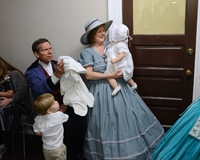
Production Cast Volunteers of the Natchez Tableau, before the performance, Natchez City Auditorium Mississippi.
Auteur :
Lo Calzo, Nicola (1979-....)Lieu de la prise de vue :
Natchez
Extrait de :
Cham, la mémoire vivante
Type :
Photographie - Couleur
Description :
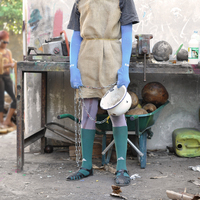
The Natchez Pilgrimage Tour was founded by a group of white women, in 1930, to compensate for the loss of resources that came with the collapse of the cotton industry and the 1929 financial crisis. Twice a year, the tour displays what is known as the «Historic Natchez Tableau», a replay of the history of Natchez, capital of the «Cotton Kingdom» until 1863. The scenes depict a presumed history of Natchez from its foundation until the present day, focusing on the splendour of landed gentry, aristocracy and the wealth of the city, without any mention of slavery on which such wealth depended. According to Cheryl Rinehart, artistic director of the «Tableau», the objective is primarily didactic: «teach young people the glorious history of the city.»
Conditions d'utilisation :
CC-BY-NC-ND - Attribution - Pas d'utilisation commerciale - Pas de modification
Provenance :
-
Notice détaillée
Titre :
Remy features a “Mas-a-Kon”, “Voukoum” group The role of the rebel, the resistant, the “Slave maroon” is staged through a particular technical and musical choice.
Auteur :
Lo Calzo, Nicola (1979-....)Lieu de la prise de vue :
Basse-Terre
Extrait de :
Cham, la mémoire vivante
Type :
Photographie - Couleur
Description :
The masks are chosen very simply and made from natural materials. The aim of these technical choices is to result in a direct incarnation of history in the individual’s body, who can claim their multiple origins and reaffirm their putting down of roots in the Guadelupian ground. The body is then becoming a direct carrier for the Caribbean identity and history, which scalds and wounds are expressed in the flesh, through the corporeal moves, through the sounds of the chains and whips. Voukoum headquarters, Basse Terre.
Conditions d'utilisation :
CC-BY-NC-ND - Attribution - Pas d'utilisation commerciale - Pas de modification
Provenance :

-
Notice détaillée
Titre :
Skull of an anonymous person, slaves cemetery of Sainte-Marguerite Bay In 1995, two cyclones furrowed the beach of the bay of Sainte-Marguerite, in the municipality of the Moule, in rapid succession.
Auteur :
Lo Calzo, Nicola (1979-....)Lieu de la prise de vue :
Le Moule
Extrait de :
Cham, la mémoire vivante
Type :
Photographie - Couleur
Description :
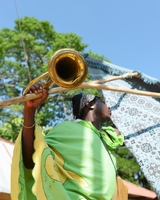
This is a very well liked picnic place for the inhabitants. In their fury, the sea and the wind uncovered many human bones, which no one expected. The following year, a team of archeologists exhumed dozens of new graves, dating from the 18th and 19th centuries. “The morphology of the skulls presented characteristics of black African populations. Some individuals had their teeth cut to a sharp point, a mutilation some people of this continent were practicing”, explains Patrice Courtaud (UMR 5199 CNRS- Anthropology unit), who led the excavations. A whole slave cemetery had been revealed from nothingness. This very rare skull, belonging to grave S225, had dental mutilations, a very rare proof of the African origin of this person and their position as a slave. More and more, important archeological excavations take place on Guadeloupe’s beaches, following fortuitous findings by the tourists or inhabitants. Indeed, slaves cemeteries were often situated near the sea or even on the beaches or unworkable and uninteresting plots for the planters. Archeological depot, Regional Archeology Unit, le Moule.
Conditions d'utilisation :
CC-BY-NC-ND - Attribution - Pas d'utilisation commerciale - Pas de modification
Provenance :
-
Notice détaillée
Titre :
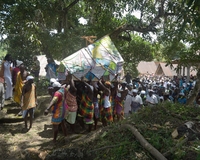
Tebini Aboikonie, one of the men who dig the Granman grave., Asindopo, Saramaka territory, Surinam.
Auteur :
Lo Calzo, Nicola (1979-....)Lieu de la prise de vue :
Suriname
Extrait de :
Cham, la mémoire vivante
Type :
Photographie - Couleur
Description :
During the days preceding the funeral, the closest family members go several times to the burial plot. This pilgrimage is punctuated by the metallic trumpet sound played by a Basia from the village to the tomb.
Conditions d'utilisation :
CC-BY-NC-ND - Attribution - Pas d'utilisation commerciale - Pas de modification
Provenance :
-
Notice détaillée
Titre :
The Belfon Aboikonie coffin goes from the burial room to the secret cemetery in the forest. Asindopo, Saramaka territory, Surinam.
Auteur :
Lo Calzo, Nicola (1979-....)Lieu de la prise de vue :
Suriname
Extrait de :
Cham, la mémoire vivante
Type :
Photographie - Couleur
Conditions d'utilisation :
CC-BY-NC-ND - Attribution - Pas d'utilisation commerciale - Pas de modification
Provenance :
