


Filtrer par

50 résultats
Exporter les résultats sélectionnés
Sélectionner tous les résultats de la page
-
Notice détaillée
Titre :
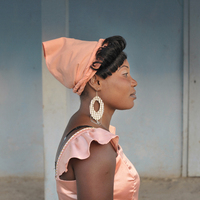
Blondine, prête à danser dans le temple de Badjo, Festivités annuelles de Badjo, Ville de Gonaïves, 2013.
Auteur :
Lo Calzo, Nicola (1979-....)Lieu de la prise de vue :
Les Gonaïves
Date :
2013
Extrait de :
Cham, la mémoire vivante
Type :
Photographie - Couleur
Description :
Les couches paysannes, désormais en grand partie urbanisées, ont intégré la mémoire de l’esclavage dans d’autres formes de narrations que celles du récit familial. Elle portent une mémoire collective ancestrale qui a choisi la religion Vaudou comme lieu principale d’expression. Le couvent de Badjo fait partie de ce qu’on appelle le Triangle d’Or, qui comprend les trois lieux sacrés les plus importants du pays: le lakou de Badjo, le lakou de Souvenance et lakou de Soukri. A chaque lakou, littéralement, «couvent», correspondant trois rites différents, respectivement Nago, Dahomey et Congo. Les trois lakou conservent des objets sacrés de Jean Jacques Dessalines qui, dans le système complexe du panthéon Vaudou haïtien, correspond à première divinité Ogou, dieu de la guerre.
Conditions d'utilisation :
CC-BY-NC-ND - Attribution - Pas d'utilisation commerciale - Pas de modification
Provenance :

-
Notice détaillée
Titre :
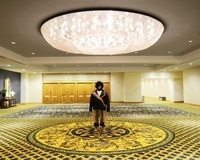
Bobby Williams wearing blackface in the Hall of the Hotel Hilton, Zulu Social Aid & Pleasure Club New Orleans.
Auteur :
Lo Calzo, Nicola (1979-....)Lieu de la prise de vue :
La Nouvelle-Orléans
Extrait de :
Cham, la mémoire vivante
Type :
Photographie - Couleur
Conditions d'utilisation :
CC-BY-NC-ND - Attribution - Pas d'utilisation commerciale - Pas de modification
Provenance :

-
Notice détaillée
Titre :
CLEMENT OLIVIER DE MONTAGUERE, descendant of Olivier de Montaguere in the family cemetery, Ouidah.
Auteur :
Lo Calzo, Nicola (1979-....)Lieu de la prise de vue :
Bénin
Extrait de :
Cham, la mémoire vivante
Type :
Photographie - Couleur
Description :
Clement is a member of this family originally from Marseille, France. His ancestor, Olivier de Montaguere, was the nineteenth steward of the French Fort for Louis XVI. He arrived in Ouidah in 1776. He brought with him his wife and their three children, Joseph, Nicolas and Jean Baptiste and organized the slave trade with the French West Indies, «He disappeared during one of his trips to the Caribbean and he is never returned to Ouidah» said Clement Olivier of Montaguere. Their descendents still live today in the old compound of their ancestor. Unlike many other local families, they have no voodoo altars in their homes, and while claiming their European origins, they strictly observe the catholic religion. Today, in the family cemetery (where I got the pictures), the oldest tomb is to Nicolas Olivier de Montaguere’s. According to the tradition, Nicolas grew up with the king of Dahomey Agonglo (1789-1797). After his adolescence spent in Abomey with the king, he returned to Ouidah in his father’s family home when he continued to deal palm oil . Nicolas and Joseph’s descendants still live in the old compound of their ancestors. They have maintained a position of prestige in the society, and historically occupy important positions in the public administration. Ouidah, Benin.
Conditions d'utilisation :
CC-BY-NC-ND - Attribution - Pas d'utilisation commerciale - Pas de modification
Provenance :
-
Notice détaillée
Titre :
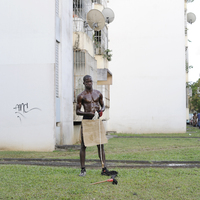
Cité Le Raizet, Les Abymes, 2012.
Auteur :
Lo Calzo, Nicola (1979-....)Lieu de la prise de vue :
Les Abymes
Date :
2012
Extrait de :
Cham, la mémoire vivante
Type :
Photographie - Couleur
Description :
Enrick features a “Mas-a-fwet”, “Mas Ka Klé” group In the context of the “Mas”, the only one missing is the white colonizer, who still appears through strong symbolic objects, like the whip, and through the figure – after all omnipresent – of the white oppressor one wants to fight and in opposition of whom one is defined. For instance, the use of whips reminds of the violence of the enslavement practiced during slavery. The masks then re-appropriate the main instrument of the slavery oppression, the symbol of a traumatic submission, in a mechanism of strategic reversal. Yet, the whip is never used to physically injure. The physical violence of the whip at the hands of the master becomes here a symbolic and moral violence in the hands of the Masks, which aims to shake the memories like an electroshock.
Conditions d'utilisation :
CC-BY-NC-ND - Attribution - Pas d'utilisation commerciale - Pas de modification
Provenance :
-
Notice détaillée
Titre :
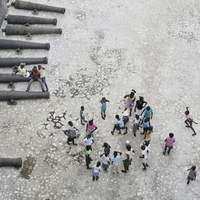
Classe en visite à la citadelle Laferrière, Ville de Milot, 2012.
Auteur :
Lo Calzo, Nicola (1979-....)Lieu de la prise de vue :
Milot
Date :
2012
Extrait de :
Cham, la mémoire vivante
Type :
Photographie - Couleur
Description :
En Haïti, la mémoire de l’esclavage ne coïncide pas vraiment avec la période coloniale mais plutôt avec la période des luttes de résistance, avec la Révolution et l’Indépendance. Ainsi, la plupart du patrimoine date de cette période. La forteresse Laferrière est construite après l’indépendance en 1804 par Henri Christophe, pour défendre la partie nord de l’île d’Haïti contre un éventuel retour des Français. C’est la plus grande forteresse des Caraïbes : à 900 mètres d’altitude, elle se trouve à 15 km au sud de Cap Haïtien. La citadelle possède un parc d’artillerie de plus de cent soixante canons qui n’ont été jamais déplacés. Ces pièces de bronze viennent de France, de Grande-Bretagne, d’Italie et d’Espagne et sont de véritables chefs-d’oeuvre de l’art militaire et de la technologie du XVIIIe siècle. Nombreuses sont les visites au complexe de la part de classes scolaires haïtiennes. À l’inverse, le tourisme international demeure presque inexistant, à exception des certains passagers de la compagnie de croisière Royal Caribbeen. Depuis le mois de mai 2012, des petits groupes des passagers ont commencé à visiter la citadelle Henri, en sortant pour la première fois de l’aire clôturée, qui leur est normalement réservée, pendant leur séjour en Haïti.
Conditions d'utilisation :
CC-BY-NC-ND - Attribution - Pas d'utilisation commerciale - Pas de modification
Provenance :

-
Notice détaillée
Titre :
David Ducros, rap singer, during the filming of his first clip «One Mic». Tremé
Auteur :
Lo Calzo, Nicola (1979-....)Lieu de la prise de vue :
La Nouvelle-Orléans
Extrait de :
Cham, la mémoire vivante
Type :
Photographie - Couleur
Description :
I Was born November 15,1993. My stage name is Big David; I’ am American rapper from New Orleans, Louisiana. Throughout my early childhood, I was a witness to the many lives that were lost and victimized by the streets. My life changed July 20.2002 after witnessing the death of my mother. I began rapping as a way to cope with the passing of my mother. By the time I was 16 I had began to work on my first mixtape as well as recording and mixing my own music. On September 24, 2010 officers acting in the undercover capacity attempted to detain me in an unlawful fashion after I struck a plain-clothes officer. I was brutally kicked and beat by as many as 3 or 4 officers. After being struck in the head with a gun, which lacerated the top of my head I was handcuffed and stomped in the head while in handcuffs. Doctors concluded that I suffered a concussion as a result of the brutal assault. After many court dates and trials I was adjudicated for resisting arrest and assaulting an officer despite the fact that I was the one who was assaulted due to the cops suspicion of me distributing narcotics. Narcotics were never found. I received 6 months of probation. I want to disseminate the injustices of my community. I have faced many impediments and have come to discern that in this day and age an oppression of our people is very much prevalent. We have been oppressed for so long that bigotry has become deeply ingrained into our minds and we remain ignorant to knowledge. Throughout my life I have remained strong allowing me to endure without despondence. Many of us cannot acknowledge the obstructions that are the foundation of an oppression but as I have said in my song Nas 1 Mic Remix, «I swear to God dope money got brothaz riding round in a member see we at war and the hood is hiroshima see they got bombs that they dropping on un but these brothaz dont’ see it yea they plotting on us cant’ put us in chains so they put us in cuffs in these underdeveloped neighborhoods brotaz call a jungle the government dont’ care about us we living a struggle». David Ducros
Conditions d'utilisation :
CC-BY-NC-ND - Attribution - Pas d'utilisation commerciale - Pas de modification
Provenance :
-
Notice détaillée
Titre :
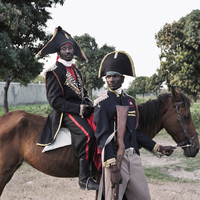
Destiné Jean Marcellus, alias Jean Jacques Dessalines avec Jean Adrien Saint Vil, alias Charlotin Marcadieu, membres du groupe «Mouvement pour la Réussite de l’Image des Héros de l’Indépendance d’Haïti», 2013.
Auteur :
Lo Calzo, Nicola (1979-....)Lieu de la prise de vue :
Port-au-Prince
Date :
2013
Extrait de :
Cham, la mémoire vivante
Type :
Photographie - Couleur
Description :
Photographie prise à la Croix-des-Bouquets, dans la banlieue de Port-au-Prince
Conditions d'utilisation :
CC-BY-NC-ND - Attribution - Pas d'utilisation commerciale - Pas de modification
Provenance :
-
Notice détaillée
Titre :
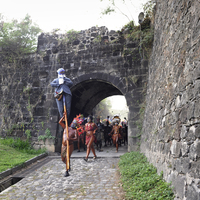
Fort Delgrès, Basse Terre
Auteur :
Lo Calzo, Nicola (1979-....)Lieu de la prise de vue :
Basse-Terre
Extrait de :
Cham, la mémoire vivante
Type :
Photographie - Couleur
Description :
The passing of the «Charge» at Fort Delgrès, Voukoum Group. The passing of the “charge” at the Fort Delgrès marks the ending of the «Mardi Gras» day, loading it with a very strong symbolic value: the Fort Delgrès is a French fort that dominates the city of Basse-Terre in Guadeloupe. It was a hotbed of Guadeloupe’s people fight against slavery, led by the resistant officer Louis Delgrès. After Napoleon re-established slavery in 1802 (after a first abolition in 1794 by Victor Hugues), Delgrès and Ignace’s rebellious colonial army occupied the fort. They abandonned it on May 22nd 1802 and took refuge at the foot of the Soufrière volcano, in Matouba. On may 28th 1802, as he saw himself lost, Delgrès and his 300 companions committed suicide with explosives, following the revolutionary motto: “to live free or to die”.
Conditions d'utilisation :
CC-BY-NC-ND - Attribution - Pas d'utilisation commerciale - Pas de modification
Provenance :
-
Notice détaillée
Titre :
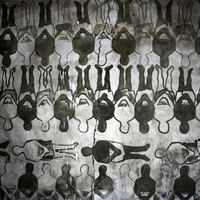
GRAFFITI in Da Silva Museum of Arts and culture, Porto Novo, Benin.
Auteur :
Lo Calzo, Nicola (1979-....)Lieu de la prise de vue :
Bénin
Extrait de :
Cham, la mémoire vivante
Type :
Photographie - Noir et blanc
Description :
Although, according to Urban-Karim-Elisio da Silva’s story, he was a descendant of a slave trader, on his father’s side, he rather identifies himself as a descendant of a slave, through his mother’s family, Paraiso. In his case, being the descendant of a slave becomes a source of pride and generates a political capital, in order to increase the legitimacy of his museum. Porto Novo, Benin
Conditions d'utilisation :
CC-BY-NC-ND - Attribution - Pas d'utilisation commerciale - Pas de modification
Provenance :
-
Notice détaillée
Titre :
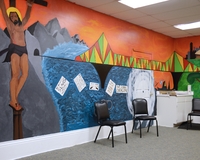
Graffiti with the Black Christ and the African American history, Youth Ministry Room, St. Peter Vlaver Ricardo, Members of the Buffalo Soldiers, Claiborne Avenue, Tremé Church, Tremé, New Orleans.
Auteur :
Lo Calzo, Nicola (1979-....)Lieu de la prise de vue :
La Nouvelle-Orléans
Extrait de :
Cham, la mémoire vivante
Type :
Photographie - Couleur
Conditions d'utilisation :
CC-BY-NC-ND - Attribution - Pas d'utilisation commerciale - Pas de modification
Provenance :
