


Filtrer par

50 résultats
Exporter les résultats sélectionnés
Sélectionner tous les résultats de la page
-
Notice détaillée
Titre :
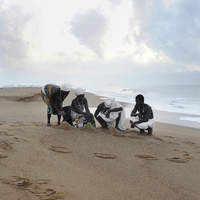
HOINDEH family on the beach in Hewé, during a private ceremony of the MAMI TCHAMBA cult, the only Voodoo cult to question the memory of African slaves.
Auteur :
Lo Calzo, Nicola (1979-....)Extrait de :
Cham, la mémoire vivante
Type :
Photographie - Couleur
Description :
The history of the Atlantic slave trade is not very active in Africa in a narrative form but it has found other forms of expression. Historical narrative and memory of the past are a part of the ritual space: the body is “owned” in the dance and music, in the incantations, in the process of divination and magic items. The Tchamba cult is one of the most significant expressions of this ritual heritage. It is represented among the populations of Ewe and Mina dialects in the coastal areas of Ghana, Togo and Benin. It is a voodoo cult dedicated to slaves, where the spirits of those who died in captivity and far from their motherland are worshiped. Ironically, those spirits have chosen their former masters’ descendants to take care of the Tchamba altar as well as their bodies, which they possess during ceremonies.
Mots-clés :
Conditions d'utilisation :
CC-BY-NC-ND - Attribution - Pas d'utilisation commerciale - Pas de modification
Provenance :

-
Notice détaillée
Titre :
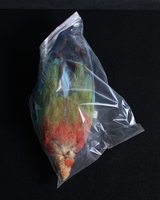
Headless, embalmed parrot. Alexandre-Franconie Departmental Museum, Cayenne, French Guiana.
Auteur :
Lo Calzo, Nicola (1979-....)Lieu de la prise de vue :
Guyane Française
Extrait de :
Cham, la mémoire vivante
Type :
Photographie - Couleur
Description :
According to Maroon tradition, forest animals are often associated with divinity. They are considered vehicles for spirits, such as Komanti, Diadja & Opete. During colonization, these animals were studied, analyzed, ranked, and finally, placed at the service of colonial propaganda to show the richness and biodiversity of French Guyana. Some of these animals are now preserved at the former colonial museum Alexandre-Franconia, Cayenne, French Guiana.
Conditions d'utilisation :
CC-BY-NC-ND - Attribution - Pas d'utilisation commerciale - Pas de modification
Provenance :
-
Notice détaillée
Titre :
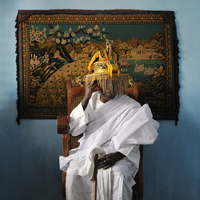
His majesty MITO DAHO KPASSÈNON, king of Ouidah and supreme head of the voodoo cult, sitting in the Audience hall, Royal Palace.
Auteur :
Lo Calzo, Nicola (1979-....)Lieu de la prise de vue :
Bénin
Extrait de :
Cham, la mémoire vivante
Type :
Photographie - Couleur
Description :
Mito Daho Kpassenon is a member of one of the oldest families of Benin, heir and descendant of King Kpassé, the first one to make business with the Europeans, particularly through the slave trade, when the Portuguese arrived in the Benin Bay around 1580. “According to the oral tradition, KPaté, one of the king’s servants, was fishing crabs on the shore when he saw white people on the beach. He took them to King KPASSE, and from that day they started trading,” tells King Kpassenon. In the early 1990s, relying on the cultural and religious exchanges established during the period of the Atlantic slave trade, and in parallel with the debates aimed at developing the Slave Route Project, he joined the project “Ouidah 92”, the world festival of voodoo culture. Like the president Songlo, by promoting the Vodun religion and the exchanges between Africa and the Americas, he presented slavery and the Atlantic slave trade not as a rupture between generations, families, and traditions but as events that produced continuity across the Atlantic. Ouidah, Benin.
Conditions d'utilisation :
CC-BY-NC-ND - Attribution - Pas d'utilisation commerciale - Pas de modification
Provenance :
-
Notice détaillée
Titre :
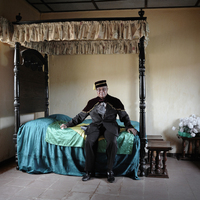
Honorè Feliciano DE SOUZA, CHACHA VIII in the memorial of Chacha I, Ouidah.
Auteur :
Lo Calzo, Nicola (1979-....)Lieu de la prise de vue :
Bénin
Extrait de :
Cham, la mémoire vivante
Type :
Photographie - Couleur
Description :
Honore Feliciano de Souza is the current head of the Aguda community and the direct heir of Don Francisco Felix de Souza, Chacha I (1754-1848), the foremost middle-men in the slave trade between the Kingdom of Dahomey and the Europeans, early XIXth century. To honor their ancestor, the family has a memorial in Singbomey, with the tomb of Chacha I. This memorial existed for many years, but became accessible to the public only in the 1990s. Paradoxically, slavery heritage official projects also helped to promote the memory of the slave merchant Francisco Felix de Souza. According to Honore Feliciano‘s unlikely opinion, “the Chacha was not involved in such a slave trade as this. At the time when the Kingdom of Dahomey was killing people, he preferred to take them to Brazil to make them work. He was in fact saving people and that is the reason why today there is some admiration for him,” he says. “Nowadays, no one would want to be a Chacha. Being Chacha is facing many hardships. I haven’t chosen to be one. On October 1995, everyone gathered here and I was appointed Chacha VIII, I cried that day. It’s a life-long mandate.” Ouidah, Benin.
Conditions d'utilisation :
CC-BY-NC-ND - Attribution - Pas d'utilisation commerciale - Pas de modification
Provenance :

-
Notice détaillée
Titre :
Imrou, Asindopo, Saramaka territory, Surinam.
Auteur :
Lo Calzo, Nicola (1979-....)Lieu de la prise de vue :
Suriname
Extrait de :
Cham, la mémoire vivante
Type :
Photographie - Couleur
Description :
Many come to Asindopo for the Granman Aboikonie ceremonies. Imrou is a Saramaka teenager who comes from Paramaribo, the capital of Surinam. For him and other youth, funerals are the opportunity to reconnect with their heritage. A funeral is also a time to socialize, to have fun and to make new connections.
Conditions d'utilisation :
CC-BY-NC-ND - Attribution - Pas d'utilisation commerciale - Pas de modification
Provenance :
-
Notice détaillée
Titre :
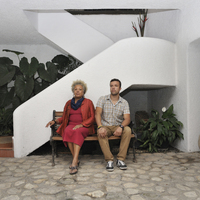
Jessie Gilbert avec son fils Louis, Descendant de Célimène, une des filles de Dessalines. Photographie prise à Pétionville, 2012.
Auteur :
Lo Calzo, Nicola (1979-....)Lieu de la prise de vue :
Pétionville
Date :
2012
Extrait de :
Cham, la mémoire vivante
Type :
Photographie - Couleur
Description :
En Haïti, la mémoire de la Révolution ne peut pas ignorer l’organisation spécifique de sa société, de type vertical, où, à chaque groupe sociale correspond une histoire particulière. D’un côté, celle de l’élite au pouvoir, constituée, en plus grand nombre, par les descendants des «affranchis» ou des «libres de couleur», et de l’autre côté, la mémoire populaire des paysans, à la campagne ou dans les périphéries urbaines, descendants des esclaves africains et créoles.
Conditions d'utilisation :
CC-BY-NC-ND - Attribution - Pas d'utilisation commerciale - Pas de modification
Provenance :
-
Notice détaillée
Titre :
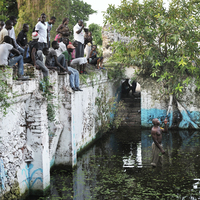
La prière du mardi sur les ruines de l’habitation «Duplaa», Lieu de culte Vaudou, Ville du Cap-Haïtien, 2012.
Auteur :
Lo Calzo, Nicola (1979-....)Lieu de la prise de vue :
Cap-Haïtien
Date :
2012
Extrait de :
Cham, la mémoire vivante
Type :
Photographie - Couleur
Description :
Dans le bassin d’eau, se manifeste un esprit nommé Lovana, qui prend la forme d’un poisson. Ses fidèles viennent prier autour du bassin, le mardi et le vendredi. Une grande fête s’y déroule le 5 septembre, la veille du pèlerinage à Bord-de-Mer-de-Limonade en l’honneur de la divinité Vaudou Sainte Philomène, ou Lasyrenn (La Sirène). Aujourd’hui en Haïti, la plupart des lieux sacrés Vaudou sont situés à la campagne sur les ruines des anciennes habitations coloniales, qui font ainsi l’objet d’une réappropriation identitaire de la part de la communauté.
Conditions d'utilisation :
CC-BY-NC-ND - Attribution - Pas d'utilisation commerciale - Pas de modification
Provenance :
-
Notice détaillée
Titre :
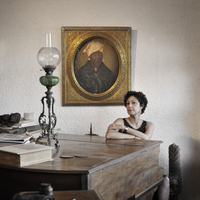
Lorraine Manuel Steed, avec le portrait de son ancêtre Marthe Adélaïde Modeste, femme africaine d’Ethiopie, arrivée comme esclave en Haïti en 1781, sur l’habitation de François Testas propriétaire au XVIIIe siècle d’une sucrerie dans le sud de Saint-Domingue. Photographie prise dans la maison familiale de Mme Steed à Pétionville, 2013.
Auteur :
Lo Calzo, Nicola (1979-....)Lieu de la prise de vue :
Pétionville
Date :
2013
Extrait de :
Cham, la mémoire vivante
Type :
Photographie - Couleur
Description :
«J’entends que tous mes nègres et négresses avec moi ici, et auxquels j’ai donné et donne la liberté soyent nourri et maintenu à mes dépens jusqu’à ce qu’ils ayent déclaré s’ils veulent ou ne veulent pas retourner à Jérémie...» 13 Juillet 1795, sept heures et demi du matin, Philadelphie. Dernières volontés de François Testas propriétaire au XVIIIe siècle d’une sucrerie dans le sud de Saint-Domingue. «Parmi les «nègres» et «négresses» à qui François Testas donne la liberté et lègue des biens se trouve mon ancêtre Marthe Adélaïde Modeste, esclave africaine». C’est ainsi qui commence le récit biographique de Lorraine Manuel Steed, qui, après cinq ans de recherche entre les Etats-Unis, la France et Haïti, et malgré une certaine opposition des parents, a pu reconstruire la vie de son ancêtre «Modeste l’Africaine».
Conditions d'utilisation :
CC-BY-NC-ND - Attribution - Pas d'utilisation commerciale - Pas de modification
Provenance :
-
Notice détaillée
Titre :
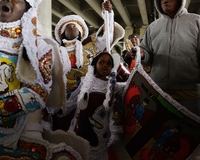
Mardi Gras Indians on Claiborne Avenue, Tremé.
Auteur :
Lo Calzo, Nicola (1979-....)Lieu de la prise de vue :
La Nouvelle-Orléans
Extrait de :
Cham, la mémoire vivante
Type :
Photographie - Couleur
Conditions d'utilisation :
CC-BY-NC-ND - Attribution - Pas d'utilisation commerciale - Pas de modification
Provenance :
-
Notice détaillée
Titre :
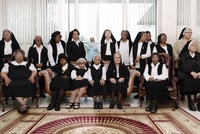
Mass, «The Sisters of the Holy family» convent, New Orleans.
Auteur :
Lo Calzo, Nicola (1979-....)Lieu de la prise de vue :
La Nouvelle-Orléans
Extrait de :
Cham, la mémoire vivante
Type :
Photographie - Couleur
Description :
The Sisters of the Holy Family, founded in New Orleans in 1842, were the first African American Catholics to serve as missionaries. Twenty years before the Civil War of the United States, and before it was legal for a Black Congregation to exist, the Sisters of the Holy Family were founded in New Orleans, Louisiana by Henriette Delille, a free woman of color. Their religious identity did not prevent the discriminations associated with their racial identity. Even permission to wear the habit that would mark their religious identity was delayed for over thirty years after their founding. The Sisters of the Holy Family remain active today, with over 200 members by operating free schools for children, nursing homes, and retirement homes in New Orleans, in US,and the Central American country of Belize. Our community had to fight to arrive here...It has always been a challenge. Even today we still go through an experience, a time where we have to consider racism, we have to work very hard to get some opportunities. In many cases it’s because of racism. The fight continues. The reason for what we fight is for the people we serve, you can see that there are some injustices and we are here to promote justice. Sister Greta Jupiter Vice-Congregational Leader.
Conditions d'utilisation :
CC-BY-NC-ND - Attribution - Pas d'utilisation commerciale - Pas de modification
Provenance :
